
Why Most Budgets Fail Before They Even Start
50/30/20 Budget Rule Here’s something nobody tells you about budgeting apps and spreadsheets: most of them die within three weeks.
Not because people are lazy or bad with money. It’s because the average budgeting system asks you to categorize every single coffee, every Uber ride, every impulse buy from Target into forty different line items. By day nine, you’re either ignoring it entirely or spending more time tracking your spending than you spent actually earning the money.
I’ve watched friends download budgeting apps with genuine enthusiasm, color-code their categories, set up automatic bank syncing and then quietly stop opening the app by the end of the month.50/30/20 Budget Not because they didn’t care about their finances. Because the system itself was exhausting.
This is exactly why the 50/30/20 rule has stuck around for over a decade while dozens of trendier budgeting methods have come and gone. It doesn’t ask you to become an accountant. It asks you to make three decisions instead of thirty, and it gives you enough flexibility to actually live your life while still building real financial stability.
If you’ve ever opened a budgeting spreadsheet, felt immediately overwhelmed, and closed the tab within two minutes, this guide is for you.
What Exactly Is the 50/30/20 Budget Rule?
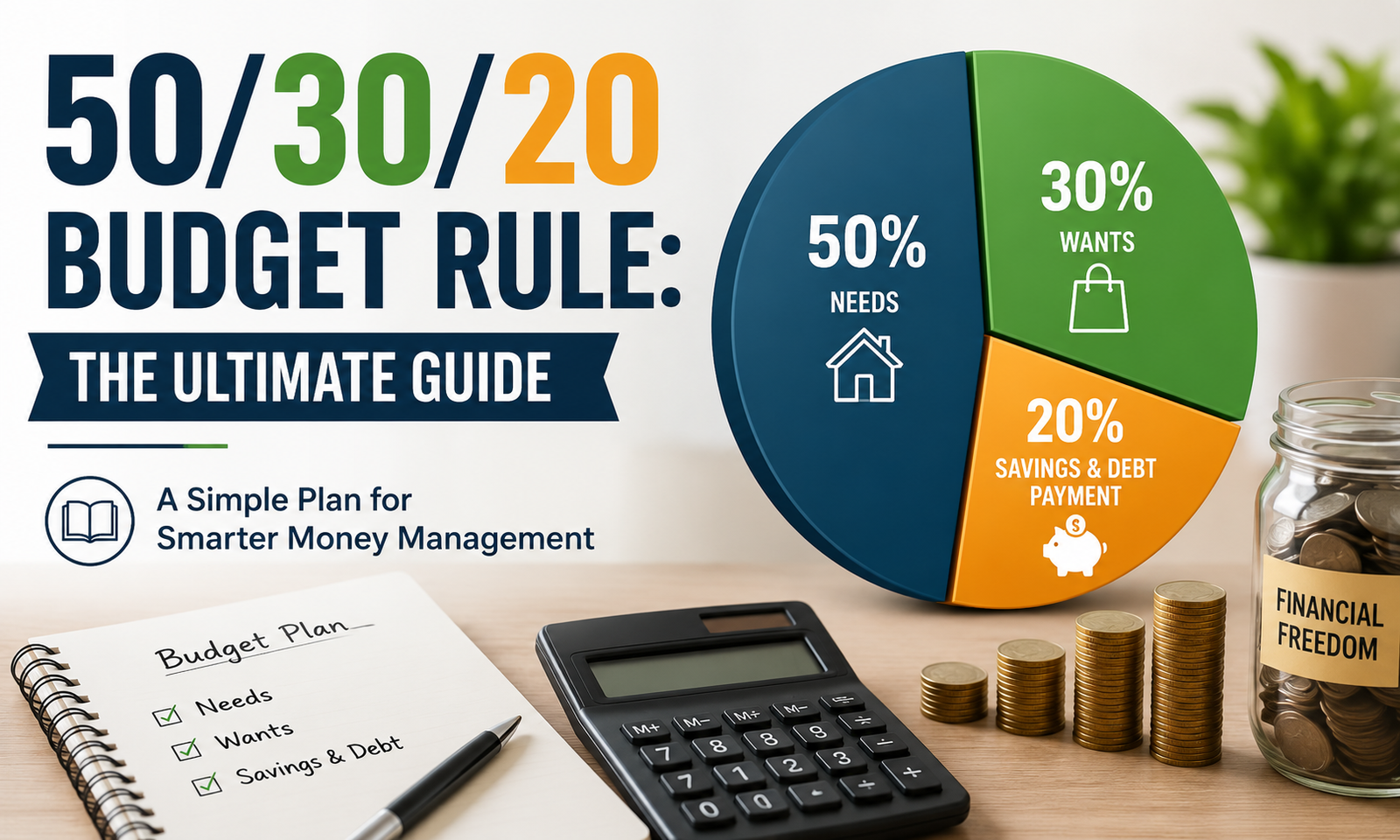
The 50/30/20 Budget rule is a simple framework for dividing your after-tax income into three buckets:
- 30% goes to wants the things that make life enjoyable but aren’t essential
- 20% goes to savings and debt repayment building your future and cleaning up your past
The concept was popularized by Senator Elizabeth Warren and her daughter, Amelia Warren Tyagi, in their book All Your Worth: The Ultimate Lifetime Money Plan, published back in 2005. What made it 50/30/20 Budget catch on wasn’t complexity it was the opposite. It gave people a mental shortcut for financial decisions without requiring a finance degree to use it.
Two decades later, it’s still one of the most recommended budgeting frameworks by financial advisors across both the US and UK, and for good reason. It works with human psychology instead of against it.
Breaking Down the Three Categories
Let’s slow down and actually look at what falls into each bucket, because this is where most people either succeed brilliantly or completely miss the point.
Table of Contents 50/30/20 Budget
- Why Most Budgets Fail Before They Even Start
- What Exactly Is the 50/30/20 Budget Rule?
- Breaking Down the Three Categories
- The 50/30/20 Budget Template (Copy This)
- How to Manage Your Monthly Income Using This Method
- Real-Life Example: Putting the Rule Into Practice
- What Counts as a “Need” vs. a “Want”? (The Part Everyone Gets Wrong)
- What to Do When 50/30/20 Budget Doesn’t Quite Fit Your Life
- Common Mistakes People Make With This Rule
- Tools That Make This Easier
- Frequently Asked Questions
- Final Thoughts
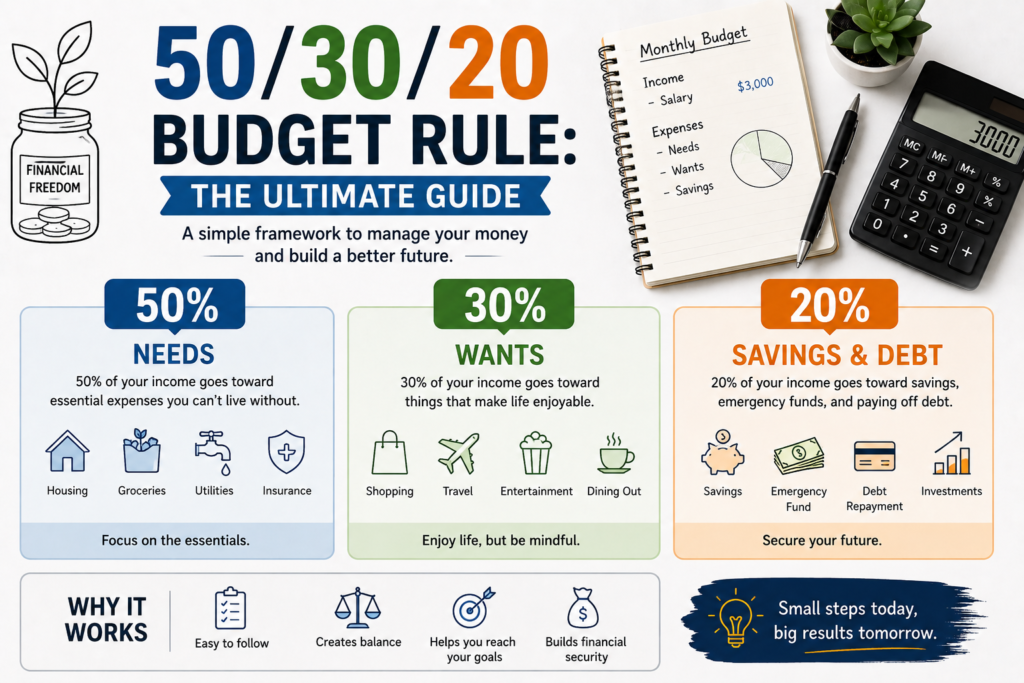
The 50%: Needs (50/30/20 Budget)
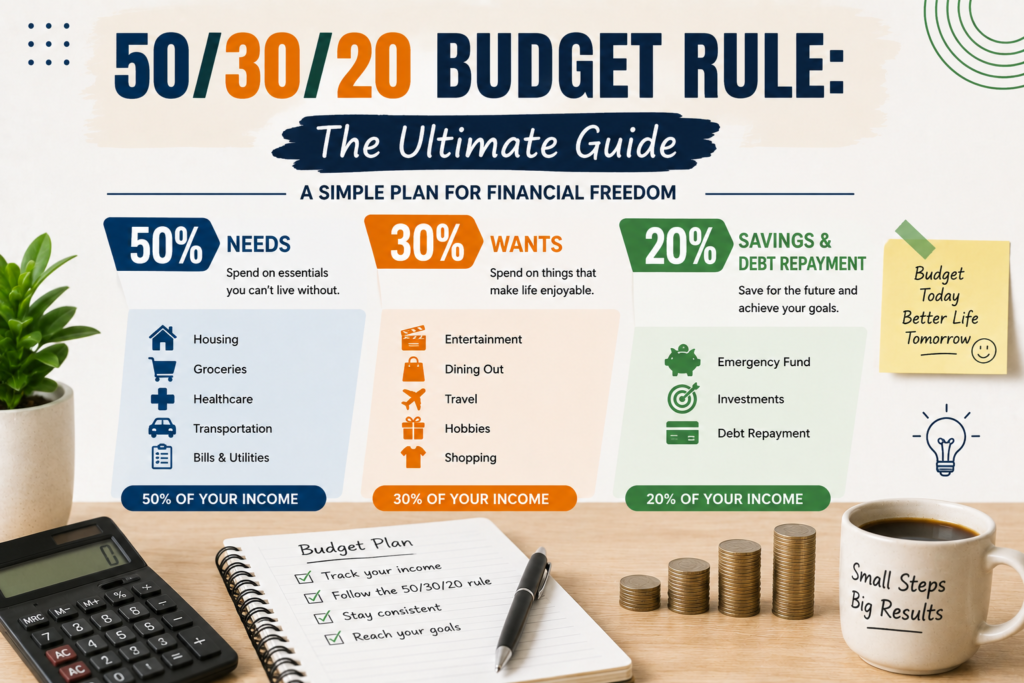
This is everything you genuinely cannot function without. Rent or mortgage payments. Utilities. Groceries (the actual grocery bill, not the wine and snacks that somehow end up in the cart). Minimum debt payments. Insurance. Transportation costs to get to work. Basic phone and internet service.
The key word here is need, not prefer. A need is something that, if you stopped paying for it, would create an immediate and serious problem in your life.
The 30%: Wants
This is where the rule gets genuinely refreshing, because it doesn’t guilt-trip you for wanting a life outside of spreadsheets. Wants include dining out, streaming subscriptions, that gym membership you actually use, vacations, hobbies, the nicer version of something when a cheaper version would technically work fine.
Notice something important: this category isn’t small. Thirty percent is a real, meaningful chunk of your income, deliberately built into the plan. The rule isn’t telling you to live like a monk. 50/30/20 Budget It’s telling you to enjoy your life within a boundary that doesn’t sabotage your future.
The 20%: Savings and Debt Repayment 50/30/20 Budget
This bucket covers your emergency fund, retirement contributions, extra payments toward debt beyond the minimum, and any other form of building financial security. This is the category most people underfund, mostly because it doesn’t feel as urgent as rent or as fun as a weekend trip.
But this 20% is really the entire point of the exercise. It’s the difference between a paycheck-to-paycheck cycle and genuine financial breathing room.
The 50/30/20 Budget Template (Copy This)
Here’s a straightforward template you can adapt to your own numbers. Let’s use a monthly take-home income of $4,000 as an example (adjust proportionally for your own income).
| Category | Percentage | Monthly Amount | Examples |
|---|---|---|---|
| Needs | 50% | $2,000 | Rent, utilities, groceries, insurance, minimum debt payments, transportation |
| Wants | 30% | $1,200 | Dining out, entertainment, subscriptions, hobbies, travel |
| Savings & Debt | 20% | $800 | Emergency fund, retirement, extra debt payments |
To build your own version:
- Calculate your monthly after-tax (take-home) income
- Multiply it by 0.50, 0.30, and 0.20 respectively
- List your actual needs and compare the total against your 50% figure
- Do the same for wants against your 30% figure
- Set up automatic transfers for your 20% the moment your paycheck lands, before you have a chance to spend it elsewhere
50/30/20 Budget
How to Manage Your Monthly Income Using This Method
Managing income with this rule comes down to sequencing the order in which you handle your money matters almost as much as the percentages themselves.
Step one: Know your actual take-home pay. Not your salary. Not your gross income. The number that actually lands in your bank account after taxes, 50/30/20 Budget health insurance premiums, and retirement contributions are deducted. This is the number the entire budget is built on.
Step two: List your needs first and total them honestly. If your needs come in under 50%, congratulations you have flexibility elsewhere. If they come in over 50%, and this happens to a lot of people, especially renters in expensive cities like London or San Francisco, don’t panic. We’ll cover what to do about that shortly.
Step three: Automate your 20% before anything else touches your account. Set up an automatic transfer to a separate savings account, retirement fund, or debt payment the day your paycheck arrives. This single habit does more for financial success than almost any other budgeting tactic.
Step four: Let the remaining 30% actually be enjoyed. This is the part people feel guilty about, and they shouldn’t. A budget that never allows for enjoyment isn’t sustainable long-term. You’ll abandon it the same way you abandoned every overly restrictive diet you’ve ever tried.
Step five: Review monthly, not daily. One of the quiet advantages of this method is that it doesn’t require obsessive daily tracking. A monthly check-in to see whether you’re roughly on target is enough. Perfection isn’t the goal general alignment is.
Real-Life Example: Putting the Rule Into Practice
Let’s talk about someone I’ll call Sarah, a marketing coordinator in Manchester earning £2,800 a month after tax. When she first looked at her spending, she genuinely had no idea where her money was going each month a common feeling that has less to do with irresponsibility and more to do with never having a framework to look through.
She broke her income down: £1,400 for needs, £840 for wants, £560 for savings and debt.
Her rent, utilities, groceries, transport, and phone bill added up to £1,320 comfortably under her 50% target. That gave her a bit of breathing room she didn’t know she had. Her wants, once she actually tracked them for a month, came in around £950, slightly over her 30% target, mostly from a habit of ordering food delivery on nights she was too tired to cook.
Rather than cutting delivery out entirely, cold turkey, she trimmed it from four nights a week down to one, redirected the difference toward her savings goal, and hit her 20% target within two months without feeling like she was depriving herself of everything enjoyable.
That’s really the whole appeal of this method. It doesn’t demand perfection on day one. It shows you where the gaps are and lets you make small, sustainable adjustments instead of a dramatic overhaul that burns out by week three.
What Counts as a “Need” vs. a “Want”? (The Part Everyone Gets Wrong)
This is genuinely the hardest part of the entire method, and it’s worth spending real time on, because getting it wrong quietly sabotages the whole system.
A lot of things masquerade as needs when they’re actually wants dressed up in practical language. The premium streaming bundle isn’t a need basic internet is. The car payment on a brand-new vehicle isn’t a need reliable transportation is, and a used, paid-off car often accomplishes the same goal for a fraction of the cost. The daily $6 coffee isn’t a need caffeine is, and it’s considerably cheaper made at home.
This isn’t about shame. It’s about honesty. The goal isn’t to strip every comfort out of your life; it’s to correctly categorize things so your budget actually reflects reality instead of self-justification.
A useful test: ask yourself whether you’d still pay for it if money were unusually tight next month. If the honest answer is no, it belongs in the “wants” category, even if it doesn’t feel like a want emotionally.
What to Do When 50/30/20 Doesn’t Quite Fit Your Life
Let’s be honest about something the personal finance world doesn’t always acknowledge: for a lot of people, especially in high-cost cities like New York, London, or San Francisco, needs alone can eat up 60% or more of take-home income. Rent has simply outpaced wage growth in a lot of places, and no budgeting framework can override that math on its own.
If this is you, here’s what actually helps:
Adjust the ratios temporarily. A 60/25/15 split isn’t a failure it’s an honest starting point. The goal is progress, not a rigid adherence to exact numbers that don’t reflect your reality yet.
Attack the needs category directly. This might mean a roommate, a smaller apartment, negotiating your rent, or refinancing debt to lower minimum payments. These are bigger, slower changes, but they move the needle far more than cutting your coffee budget ever will.
Increase income where possible. A budget can only redistribute existing money it can’t create more of it. Sometimes the real fix isn’t a tighter budget; it’s a raise, a side income stream, or a job change.
Protect at least something for savings, even if it’s small. Even 5% is better than 0%. The habit of automatic saving matters more early on than the actual amount.
The 50/30/20 rule was always meant to be a framework, not a rigid law. The people who succeed with it long-term are the ones who treat it as a flexible starting point rather than a strict rulebook they’ve failed the moment they deviate from it.
Common Mistakes People Make With This Rule
Treating the percentages as sacred and unchangeable. They’re a guideline built for the average person’s situation, not a mathematical law of the universe. Adjust them to fit your actual life.
Forgetting to include irregular expenses. Car repairs, annual subscriptions, holiday gifts, birthday costs — these tend to get forgotten in monthly budgeting and then show up as “surprise” expenses that blow the whole plan. Averaging these out monthly and setting aside a small amount prevents this.
Confusing gross income with take-home income. Building a budget around your salary before taxes is one of the fastest ways to end up with a budget that doesn’t match reality.
Giving up after one imperfect month. Nobody hits these percentages exactly on the first try. The method is meant to be iterative, not perfect from day one.
Neglecting the 20% because it feels less urgent. Rent has a due date. Savings often doesn’t, which makes it easy to quietly skip. Automating it removes this problem entirely.
Tools That Make This Easier
You genuinely don’t need expensive software for this method that’s part of its appeal. A simple spreadsheet with three columns works perfectly well. That said, if you’d prefer something automated, budgeting apps like YNAB, Monzo (particularly useful for UK-based readers, with built-in spending categories), or Empower can automatically sort transactions and show you, in real time, how close you are to each of your three targets.
The tool matters far less than the consistency of checking in on it. A basic spreadsheet reviewed monthly will outperform a sophisticated app that gets ignored.
Frequently Asked Questions
1. Does the 50/30/20 rule work with irregular income, like freelance work?
Yes, with a small adjustment. Base your percentages on your average monthly income over the past six to twelve months rather than a single month, and treat higher-earning months as an opportunity to boost your savings percentage rather than your spending.
2. Should retirement contributions count toward the 20%, or are they separate?
Most financial advisors count retirement contributions as part of the 20%, alongside emergency savings and extra debt payments. If your employer offers a 401(k) or workplace pension match, prioritize contributing enough to get the full match first, since that’s essentially free money.
3. What if my minimum debt payments alone take up more than 20%?
Move minimum debt payments into your “needs” category rather than your savings category, since they’re non-negotiable monthly obligations. Extra, above-minimum debt payments can still count toward your 20% savings goal.
4. Is this budgeting method suitable for people with very low income?
It can be more difficult to apply strictly, since needs often consume a much larger percentage when income is limited. In these cases, focus on getting even a small percentage into savings and treat the ratios as long-term goals to work toward rather than an immediate requirement.
5. How strict do I need to be with the percentages each month?
Not very. Financial experts generally suggest treating these as rough targets reviewed monthly rather than daily rules. A month where wants hit 35% instead of 30% isn’t a failure it’s useful information for the following month.
6. Can couples use this budgeting method together?
Yes, and many find it especially useful for combined finances, since it creates a shared, simple framework rather than a detailed argument over every individual purchase. Combine both incomes, apply the percentages to the household total, and revisit together monthly.
7. What’s the difference between this and zero-based budgeting?
Zero-based budgeting assigns every single dollar a specific job down to the last cent, which offers more precision but requires significantly more ongoing effort. The 50/30/20 rule trades some precision for simplicity and sustainability, which is why many people stick with it longer.
8. Should I follow this rule before or after paying off debt aggressively?
The rule already accounts for debt within its structure minimum payments fall under needs, and extra payments fall under the 20% savings category. If you’re following a more aggressive payoff strategy like the debt avalanche or snowball method, you can temporarily shift more of your 30% wants category toward that 20% bucket until the debt is cleared.
Final Thoughts
The 50/30/20 rule has lasted this long not because it’s revolutionary, but because it respects something most budgeting advice ignores: people don’t stick with systems that feel like punishment. It gives you structure without suffocating you, and it builds savings into the plan by default instead of treating it as an afterthought you’ll “get to eventually.”
If you take one thing from this guide, let it be this: you don’t need a perfect budget. You need one you’ll actually follow past the third week. Start with the percentages, adjust them honestly to fit your real life, automate the savings piece so it doesn’t rely on willpower, and revisit it monthly rather than obsessing daily.
Money management isn’t about restriction. It’s about direction. The 50/30/20 rule simply gives you a map where you go from there is entirely up to you.
Frequently Asked Questions: The 50/30/20 Budgeting Rule
1. Does the 50/30/20 rule work with irregular income, like freelance work?
Yes, with a small adjustment. Base your percentages on your average monthly income over the past six to twelve months rather than a single month, and treat higher-earning months as an opportunity to boost your savings percentage rather than your spending.
2. Should retirement contributions count toward the 20%, or are they separate?
Most financial advisors count retirement contributions as part of the 20%, alongside emergency savings and extra debt payments. If your employer offers a 401(k) or workplace pension match, prioritize contributing enough to get the full match first, since that’s essentially free money.
3. What if my minimum debt payments alone take up more than 20%?
Move minimum debt payments into your “needs” category rather than your savings category, since they’re non-negotiable monthly obligations. Extra, above-minimum debt payments can still count toward your 20% savings goal.
4. Is this budgeting method suitable for people with very low income?
It can be more difficult to apply strictly, since needs often consume a much larger percentage when income is limited. In these cases, focus on getting even a small percentage into savings and treat the ratios as long-term goals to work toward rather than an immediate requirement.
5. How strict do I need to be with the percentages each month?
Not very. Financial experts generally suggest treating these as rough targets reviewed monthly rather than daily rules. A month where wants hit 35% instead of 30% isn’t a failure — it’s useful information for the following month.
6. Can couples use this budgeting method together?
Yes, and many find it especially useful for combined finances, since it creates a shared, simple framework rather than a detailed argument over every individual purchase. Combine both incomes, apply the percentages to the household total, and revisit together monthly.
7. What’s the difference between this and zero-based budgeting?
Zero-based budgeting assigns every single dollar a specific job down to the last cent, which offers more precision but requires significantly more ongoing effort. The 50/30/20 rule trades some precision for simplicity and sustainability, which is why many people stick with it longer.
8. Should I follow this rule before or after paying off debt aggressively?
The rule already accounts for debt within its structure minimum payments fall under needs, and extra payments fall under the 20% savings category. If you’re following a more aggressive payoff strategy like the debt avalanche or snowball method, you can temporarily shift more of your 30% wants category toward that 20% bucket until the debt is cleared.
9. What if I live somewhere with a very high cost of living and can’t get needs under 50%?
This is common in cities like London, New York, or San Francisco. Rather than abandoning the method, adjust the ratios temporarily something like 60/25/15 and treat the standard 50/30/20 split as a longer-term goal to work toward as income grows or major expenses like rent are renegotiated.
10. How do I stick with this budget long-term instead of abandoning it after a few weeks?
Automate your 20% so it doesn’t rely on willpower, review your numbers monthly instead of daily to avoid burnout, and allow yourself the full 30% for wants without guilt restrictive budgets that don’t permit any enjoyment tend to get abandoned quickly, the same way overly strict diets do.
Read about Emergency Fund Fast