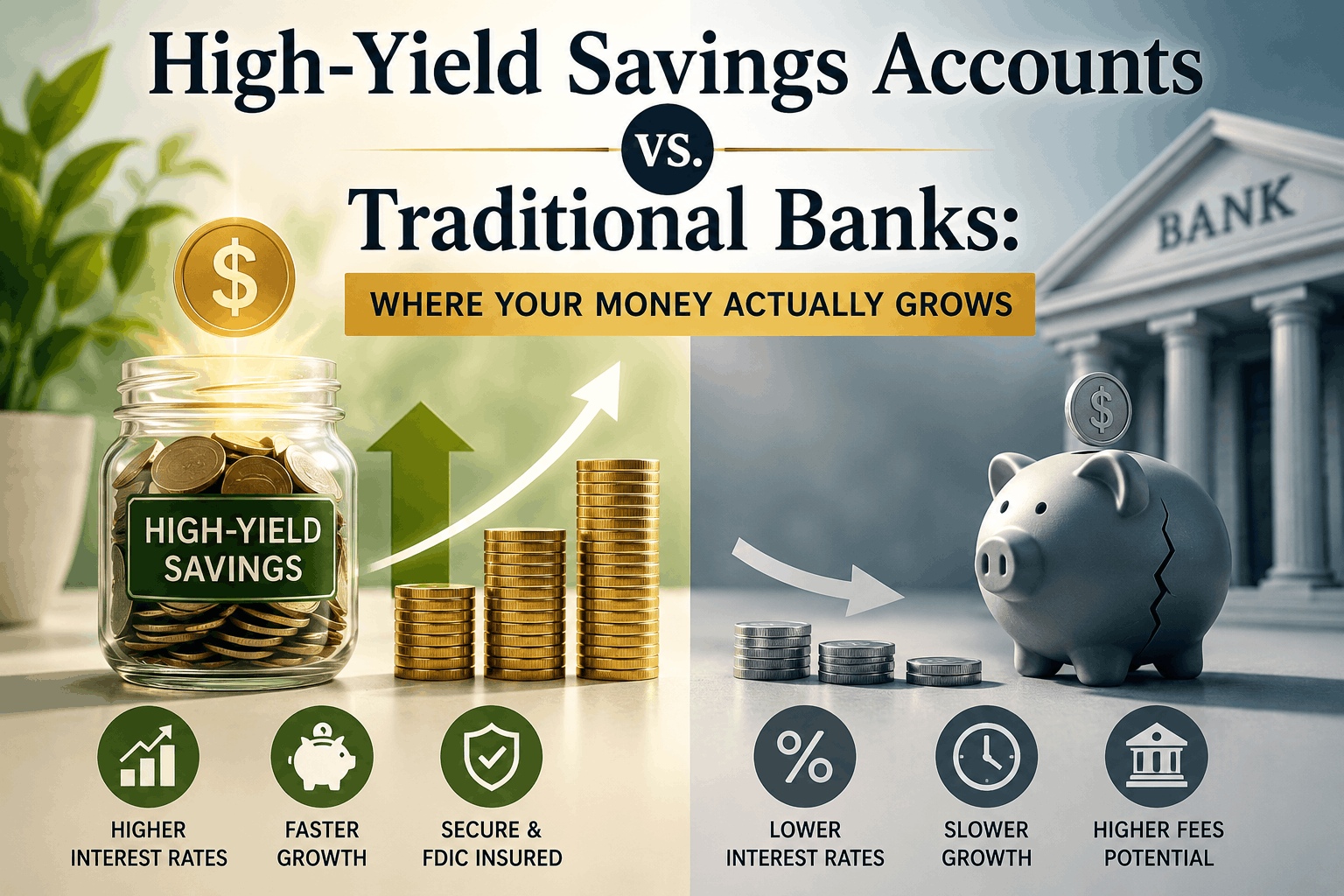
Yield Savings Accounts Here’s a number that should annoy you a little: the average traditional savings account in the US pays around 0.38% interest, according to FDIC data. That means if you kept $10,000 sitting in a typical savings account at a big traditional bank for a full year, you’d earn less than the cost of a nice dinner out. Meanwhile, that same $10,000 in one of today’s better high-yield accounts could be earning you well over ten times that amount, doing absolutely nothing different except sitting in a different digital vault.
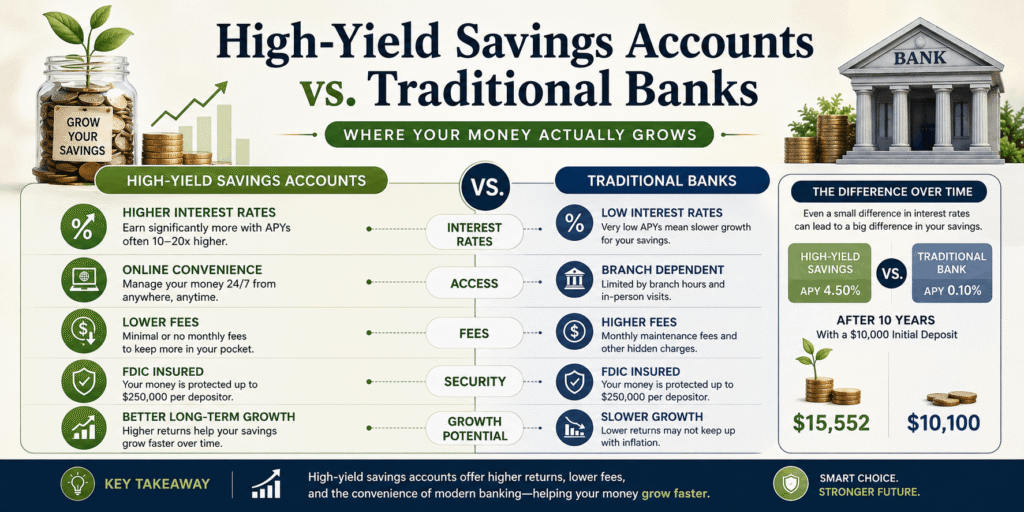
I remember the exact moment this clicked for me. I was helping a family member move money between accounts, glanced at her statement, and realized she’d had five figures sitting in a savings account at her local branch the same bank her parents used, the same bank she’d banked with since she was eighteen earning what basically rounded to nothing. She wasn’t careless. She just hadn’t ever been given a reason to look elsewhere. That’s the story for a huge number of savers on both sides of the Atlantic, and it’s exactly what this article is here to fix.
Table of Contents
- What Actually Separates a High-Yield Savings Accounts from a Traditional One
- Why Traditional Banks Pay So Little in the First Place
- How Much Difference Are We Actually Talking About
- What the Best Rates Look Like Right Now
- Understanding Passive Income from Savings
- Safety, Insurance, and What You’re Really Risking
- What You Give Up by Switching to a High-Yield Account
- How to Actually Choose the Right Account
- Mini Case Studies: Three Different Savers, Three Different Choices
- Common Mistakes People Make When Switching
- Final Thoughts
- FAQ
What Actually Separates a High-Yield Account from a Traditional One
At the most basic level, both account types do the same job: they hold your cash and pay you interest for letting the bank use it. The difference is entirely in how much interest you actually get, and a handful of features that come along with that trade.
Traditional savings accounts, the kind offered by big-name banks with branches on every corner, tend to pay minimal interest almost as an afterthought. Yield Savings Accounts You’re paying, in a sense, for the convenience of physical branches, in-person customer service, and often a broader suite of linked products like checking accounts, mortgages, and credit cards under one roof.
High-yield savings accounts, most commonly offered by online-only banks or digital arms of larger institutions, strip away the physical branch network and pass the savings from that lower overhead directly to you in the form of a meaningfully higher interest rate. You typically manage everything through an app or website, transfers to and from a linked external account take a day or two rather than being instant, and customer service happens over phone or chat rather than face to face.
That’s really the core trade: convenience and physical presence versus meaningfully better returns on your cash.
Why Traditional Banks Pay So Little in the First Place
It’s worth understanding the actual mechanics here, because it explains why this gap exists and isn’t likely to disappear.
Traditional banks with extensive branch networks carry substantial overhead rent, staff, physical security, maintenance costs that online-only banks simply don’t have. On top of that, many traditional bank customers keep their savings at the same institution as their checking account purely out of convenience, rarely shopping around, which means those banks face very little competitive pressure to offer better rates.Yield Savings Accounts When customers aren’t likely to leave over a rate difference, there’s limited business incentive to raise it.
Online-only, high-yield savings providers operate on the opposite logic. With minimal physical overhead and a customer base that specifically shops around for the best possible rate, they have to compete aggressively on yield to attract and retain deposits. That competitive pressure is a huge part of why the rate gap between traditional and high-yield accounts has remained so persistently wide.
How Much Difference Are We Actually Talking About
Let’s make this concrete rather than abstract, because the gap tends to sound modest as a percentage but adds up meaningfully in real dollars.
Say you have $15,000 in savings. At a traditional bank paying close to the national average, you might earn somewhere in the range of $50 to $60 over a full year. At a competitive high-yield account currently paying somewhere around 4% APY, that same $15,000 could generate roughly $600 over the same period, assuming the rate holds steady. That’s not a rounding error that’s the difference between essentially nothing and a genuinely useful chunk of extra money, generated purely by choosing where you park cash you already have.
The gap compounds further the more you save and the longer you leave it untouched, since interest earned also starts earning its own interest over time. It’s a small, quiet kind of financial gain, but it’s one of the very few places in personal finance where you genuinely get more return for doing less no extra risk, no extra effort, just a smarter choice about where the money physically sits.
What the Best Rates Look Like Right Now
Rates move regularly based on broader economic conditions, so treat any specific number as a snapshot rather than a permanent fact but the current landscape gives a useful sense of scale.
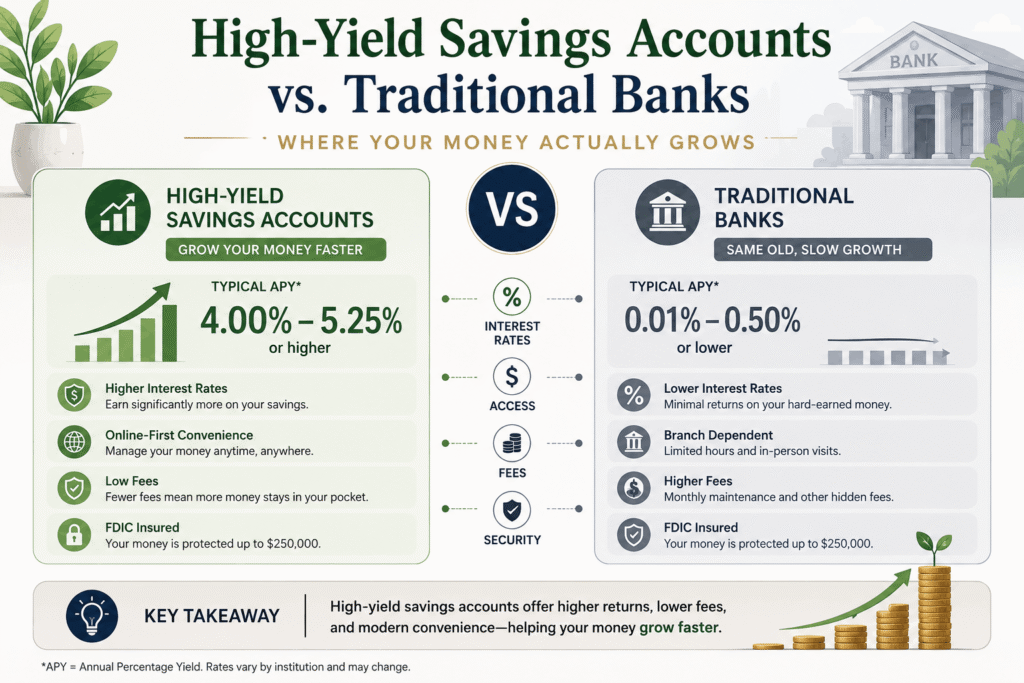
In the US, some of the strongest high-yield savings rates currently available sit in the range of roughly 4.0% to 4.15% APY, with some accounts advertising APYs as high as around 4.20%. That’s a dramatic gap compared to the sub-half-percent rates typical of traditional accounts. It’s also worth knowing that rates across the market have been trending gently downward in recent months, which is a normal part of the interest rate cycle rather than a sign that high-yield accounts are becoming a bad option they remain far ahead of traditional accounts even as top rates ease slightly.
In the UK, the picture is broadly similar in spirit. The Bank of England base rate stood at 3.75% as of July 2026, and that base rate heavily influences what savings providers are willing to offer. Some easy access savings accounts have advertised rates as high as around 5% AER, though it’s worth reading the fine print closely, since the very top rates are often promotional, time-limited offers that revert to a lower standard rate after a set period. Even setting aside those promotional peaks, ongoing competitive easy access rates in the UK have generally sat comfortably above what most traditional high street banks offer on a standard savings account.
The practical takeaway on both sides of the Atlantic is the same: don’t fixate on chasing the single highest advertised number, especially if it’s a short-term promotional rate. Look instead at the realistic, ongoing rate you’ll actually earn month after month, since that’s what actually compounds into meaningful passive income over time.
Understanding Passive Income from Savings
The phrase “passive income” gets thrown around a lot in the context of side hustles and investment strategies, but a well-chosen high-yield savings account is genuinely one of the simplest, lowest-effort forms of it available to ordinary savers.
Unlike other passive income strategies rental property, dividend stocks, building an audience for ad revenue a high-yield savings account requires essentially no ongoing effort once it’s set up. You’re not managing tenants, monitoring a portfolio, or creating content. Yield Savings AccountsYou open the account, move money in, and the interest accrues automatically, typically compounding daily or monthly and getting deposited into your balance without you lifting a finger.
This makes it a particularly good fit for an emergency fund or short-term savings goal money you want accessible and safe, but that you’d still like to be quietly growing rather than sitting completely idle. It’s not going to replace a genuine long-term investment strategy for building wealth, since even the best current savings rates typically trail long-run stock market returns over extended time horizons. But for the portion of your money that needs to stay liquid and low-risk, a high-yield account turns dead weight into modest, dependable passive income, which is a meaningfully better outcome than the alternative of earning almost nothing at all.
Safety, Insurance, and What You’re Really Risking
This is often the first hesitation people raise, and it’s a fair question worth addressing directly: is a high-yield account, especially one from an online-only bank you’ve never heard of, actually safe?
In the US, deposits at FDIC-member banks are insured up to $250,000 per depositor, per institution, per ownership category the exact same protection you get at a large traditional bank. Most reputable Yield Savings Accounts savings providers, even the online-only ones, are backed by FDIC-insured partner banks, so your deposit protection is generally identical to what you’d have at a household-name traditional bank, provided the account is genuinely FDIC insured.
In the UK, the Financial Services Compensation Scheme protects up to £120,000 per person, per authorized institution, which similarly applies to online Yield Savings Accounts savings providers regulated by the Financial Conduct Authority, not just traditional high street banks. All financial services companies operating in the UK must be authorized by the Financial Conduct Authority, which is a straightforward thing to verify before opening any new account.
The real practical risk with high-yield accounts isn’t safety of your deposit it’s usually more about convenience and access speed, which we’ll get into next. Before opening any account, it’s worth directly confirming that deposit protection applies and checking which specific institution actually holds and insures the funds, since some online banks operate through a partner bank relationship rather than holding a banking license themselves.
What You Give Up by Switching to a High-Yield Account
It would be dishonest to present this as a decision with no downsides at all, so here’s the honest list of trade-offs.
Slower access to your cash. Most high-yield accounts require an electronic transfer to move money to a linked checking account, which typically takes one to a few business days, rather than the instant access you’d get walking into a branch or using an ATM tied directly to your savings.
No in-person support. If you value being able to sit down with a human banker to sort out an issue, online-only providers won’t offer that. Support happens through chat, phone, or email instead.
No bundled products in the same place. Traditional banks often make it convenient to have checking, savings, credit cards, and loans all under one login. High-yield savings providers are frequently more limited in scope, sometimes offering little beyond the savings account itself.
Rates are variable, not fixed. The attractive rate you sign up for today isn’t locked in. High-yield savings rates move with broader interest rate trends, meaning your rate could decrease over time, sometimes significantly, depending on economic conditions.
Occasional account requirements. Some of the most competitive rates come with strings attached minimum balance requirements, linked checking accounts, or direct deposit requirements needed to unlock the advertised top rate, so the number in the headline isn’t always the number you’ll actually earn.
How to Actually Choose the Right Account
Check the realistic, ongoing rate, not just the headline promotional one. If an offer looks unusually generous, check whether it’s temporary and what the rate reverts to afterward.
Confirm deposit insurance directly. Look for explicit confirmation of FDIC coverage in the US or FSCS protection in the UK, and identify which specific institution is actually holding your money.
Read the fine print on requirements. Minimum balances, required linked accounts, or monthly deposit thresholds can significantly affect whether you’ll actually earn the advertised rate.
Consider how quickly you might need the money. If this is meant to be a true emergency fund, prioritize accounts with straightforward, reasonably fast transfer processes over accounts with the single highest rate but clunkier withdrawal procedures.
Look at the account’s fee structure. Even savings accounts can carry monthly maintenance fees or excessive withdrawal penalties in some cases, which can quietly eat into the extra interest you’re earning.
Don’t feel obligated to consolidate everything with one provider. It’s entirely reasonable to keep your everyday checking account at your familiar traditional bank while moving your savings elsewhere for a better rate. These decisions don’t need to be all-or-nothing.
Mini Case Studies: Three Different Savers, Three Different Choices
The emergency fund builder. A young professional in the US had about $8,000 sitting in a traditional savings account earning next to nothing. She moved it into a high-yield account with no minimum balance requirement and free, unlimited transfers, prioritizing accessibility over squeezing out the absolute highest available rate, since this money existed specifically to be available in a real emergency.
The UK saver chasing a house deposit. A couple saving toward a home deposit in the UK split their savings between a fixed-rate account for the portion they were confident they wouldn’t need for at least a year, Yield Savings Accounts locking in a guaranteed rate, and an easy access account for a smaller buffer they wanted to keep flexible, balancing better guaranteed returns against the need for some accessible cash.
The retiree prioritizing simplicity. A retired couple who valued face-to-face banking relationships decided the modest rate difference wasn’t worth giving up their long-standing relationship with a local branch and in-person advisor, choosing to keep the bulk of their savings at their traditional bank while moving only a portion the part they were confident they wouldn’t need quickly into a higher-yield account for the extra return.
None of these choices is objectively “correct” for everyone. They reflect genuinely different priorities, and that’s the actual point: the best account depends on what you personally need from your money, not just which provider tops the rate comparison chart that week.
Common Mistakes People Make When Switching
Chasing a promotional rate without reading when it expires. Many of the flashiest advertised rates are time-limited, and failing to note when they revert can leave you unknowingly earning a much lower rate than expected after a few months.
Forgetting to actually verify deposit insurance. Assuming a bank is insured rather than directly confirming it is a completely avoidable risk that takes only a minute to check.
Moving money without a clear transfer plan. Because high-yield account transfers aren’t instant, moving your entire emergency fund without keeping any accessible cash in the interim can leave you temporarily unable to cover a sudden, urgent expense.
Not reviewing the rate periodically after opening the account. Since rates are variable, the account that was the best option when you opened it might not remain the most competitive a year later. It’s worth checking in on your rate roughly once or twice a year rather than assuming it’s permanently optimal.
Overcomplicating things with too many accounts. Spreading savings across numerous high-yield accounts purely to chase small rate differences often creates more complexity than the marginal extra interest is actually worth for most savers.
Final Thoughts
The gap between what a traditional bank pays and what a competitive high-yield account offers isn’t a temporary quirk or a gimmick it’s a structural difference that’s persisted for years and shows no real sign of closing.Yield Savings Accounts Letting a meaningful chunk of your savings sit in an account earning next to nothing isn’t a mistake exactly, since most people simply never had a compelling reason to look elsewhere. But now you do.
You don’t need to overhaul your entire financial life to benefit from this. You just need to move the cash you’re not actively using for daily spending into an account that actually works for you, rather than one that quietly does nothing while you’re not looking. Yield Savings Accounts It’s one of the rare financial decisions that carries essentially no added risk and no real downside beyond a small amount of setup time.
If you take one action away from this article, let it be this: log into your current savings account today, look at the actual interest rate you’re earning, Yield Savings Accounts and ask yourself honestly whether it’s still good enough. If the answer is no, you now know exactly what to look for instead.
FAQ Yield Savings Accounts
1. Is my money actually safe in a high-yield savings account from an online bank?
Generally yes, provided the institution is properly insured FDIC insurance in the US or FSCS protection in the UK which most reputable Yield Savings Accounts providers carry, even if they operate entirely online. Always verify this directly before opening an account.
2. Can a high-yield savings account’s interest rate change after I open it?
Yes. Most high-yield savings accounts carry variable rates that move with broader economic and interest rate conditions, meaning your rate today isn’t guaranteed to stay the same over time.
3. Do I have to close my traditional bank account to open a high-yield savings account?
No. Many savers keep their everyday checking account at a traditional bank for convenience while moving their savings to a separate high-yield account purely for the better return.
4. How quickly can I access my money in a high-yield savings account?
It varies by provider, but most require an electronic transfer to a linked account, typically taking one to a few business days, rather than offering instant access through a branch or linked ATM.
5. Is there a minimum amount of money needed to open a high-yield savings account?
It depends on the specific provider. Many popular options have no minimum balance requirement at all, while others require a minimum deposit or ongoing balance to earn the advertised top rate.
6. Are high-yield savings accounts a good substitute for investing in the stock market?
Not really, for long-term wealth building specifically. They’re better suited for short-term savings goals and emergency funds where safety and liquidity matter more than maximizing long-run growth, since even strong savings rates typically trail long-term average stock market returns.
7. How often should I check whether I’m still getting a competitive savings rate?
Roughly once or twice a year is a reasonable habit, since rates shift over time and the account that offered the best return when you opened it may not remain the most competitive option indefinitely.
This article is for general informational purposes and shouldn’t be taken as personalized financial advice. Rates mentioned reflect market conditions at the time of writing and will change; always check current rates directly with providers before making a decision.
Read avout 50/30/20 Budget