
The 2 AM Phone Call Nobody’s Ready For
A friend of mine got the call on a Tuesday. Her company was “restructuring,” effective immediately. No warning, no severance conversation beforehand, just a fifteen-minute meeting and a box for her desk items by Friday.She had about three weeks of expenses saved. What followed wasn’t just the stress of job hunting it was the compounding stress of watching her bank balance shrink while trying to make good decisions under pressure. She took the first job offer that came along, not because it was right for her, but because she couldn’t afford to wait for the right one.That’s the real cost of not having an emergency fund. It’s not just the financial hit. It’s the way scarcity forces you into decisions you wouldn’t otherwise make, at exactly the moment you need clear thinking the most.
A six-month emergency fund sounds like a lot when you first hear the number. It can feel almost mythical, like something other people have, people with better jobs or fewer obligations. But it’s genuinely achievable, even on an ordinary income, if you approach it with the right strategy instead of just vaguely hoping to “save more” someday.
Let’s get into exactly how.
Why Six Months, Specifically?
You’ve probably heard different numbers thrown around three months, six months, even a full year. So why does six tend to be the benchmark most financial advisors land on?The answer comes down to how long real financial disruptions actually last. Data from both the US Bureau of Labor Statistics and the UK’s Office for National Statistics has consistently shown that the average job search, particularly for mid-career professionals, tends to stretch beyond the three-month mark, especially during economic downturns or in competitive industries. Three months of savings might get you through the search. It might not get you through the search plus the gap before your first paycheck actually lands.Six months also accounts for something people often forget: emergencies rarely happen in isolation. Job loss frequently coincides with other stressors a health issue, a car that picks the worst possible moment to break down, a family member who needs support. A six-month cushion gives you room to absorb more than one problem at once, which is closer to how real life tends to unfold.
That said, six months isn’t a universal law carved in stone. It’s a well-reasoned target, not a rigid requirement, and we’ll talk shortly about how to adjust it based on your actual situation.
Table of Contents
- The 2 AM Phone Call Nobody’s Ready For — Introduction
- Why Six Months, Specifically?
- How Much Money Are We Actually Talking About?
- Where to Actually Keep This Money
- What You Want From an Emergency Fund Account
- The Best Options, Realistically
- The One Split Worth Considering
- The Actual Strategy: How to Build It Fast
- Step 1: Start With a Smaller, Immediate Target
- Step 2: Audit Your Expenses Like You Actually Mean It
- Step 3: Automate the Transfer, Every Single Payday
- Step 4: Redirect Windfalls Immediately
- Step 5: Create a Temporary Income Boost
- Step 6: Use a Visual Tracker
- A Realistic Timeline Example
- What If Six Months Genuinely Isn’t Realistic Right Now?
- The Mindset Shift That Actually Makes This Work
- Final Thoughts Conclusion
How Much Money Are We Actually Talking About?
This is where a lot of people get stuck before they even start, because the number can feel abstract until you actually calculate it.Here’s the calculation that matters: your emergency fund should be based on your essential monthly expenses, not your total income. This is a crucial distinction. You’re not trying to replace your entire paycheck, lifestyle spending and all. You’re trying to cover what it actually costs to keep your life running rent or mortgage, utilities, groceries, insurance, minimum debt payments, transportation, and other genuine necessities.
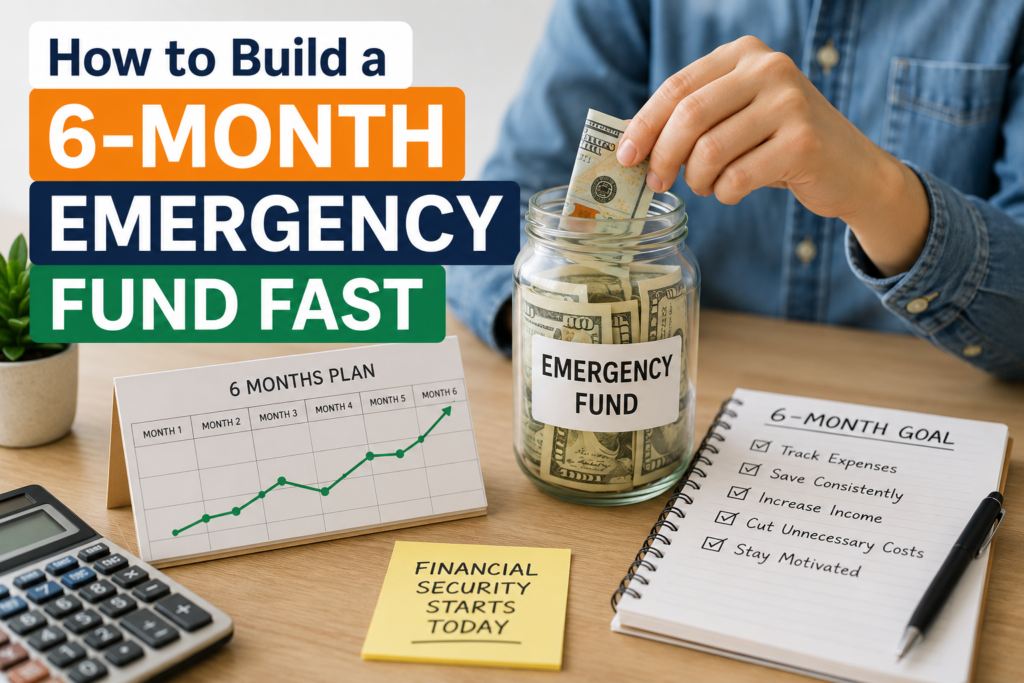
A simple way to calculate your target:
For example, if your essential expenses come to $2,800 a month, your six-month target is $16,800. If your essentials run closer to £1,900 a month in the UK, you’re looking at roughly £11,400.Seeing the full number can feel overwhelming, and that’s completely normal. The trick, which we’ll cover in detail, is to stop looking at the whole mountain and start looking at the next reasonable step in front of you.
Where to Actually Keep This Money
Before diving into how to build the fund, it’s worth addressing a question that trips people up constantly: once you have this money, where does it actually go?
This matters more than people realize, because the wrong storage location can either quietly erode your fund’s value or make it inaccessible exactly when you need it most.
What You Want From an Emergency Fund Account
Your emergency fund needs to satisfy three requirements simultaneously, and it’s a genuine balancing act:
Liquidity. You need to be able to access this money quickly, ideally within a day or two, without penalties or complicated withdrawal processes. This immediately rules out things like retirement accounts, which often carry penalties for early withdrawal, and locked-in investments that take time to liquidate.
Safety. This is not the money you invest in the stock market, no matter how tempting a strong market year might make that idea look. Emergency funds exist specifically to be stable when everything else in your life isn’t. A market downturn hitting at the exact moment you lose your job would be a genuinely brutal combination.
Some growth. While safety and liquidity come first, there’s no reason to let this money sit in a checking account earning virtually nothing while inflation quietly eats away at its value.
The Best Options, Realistically
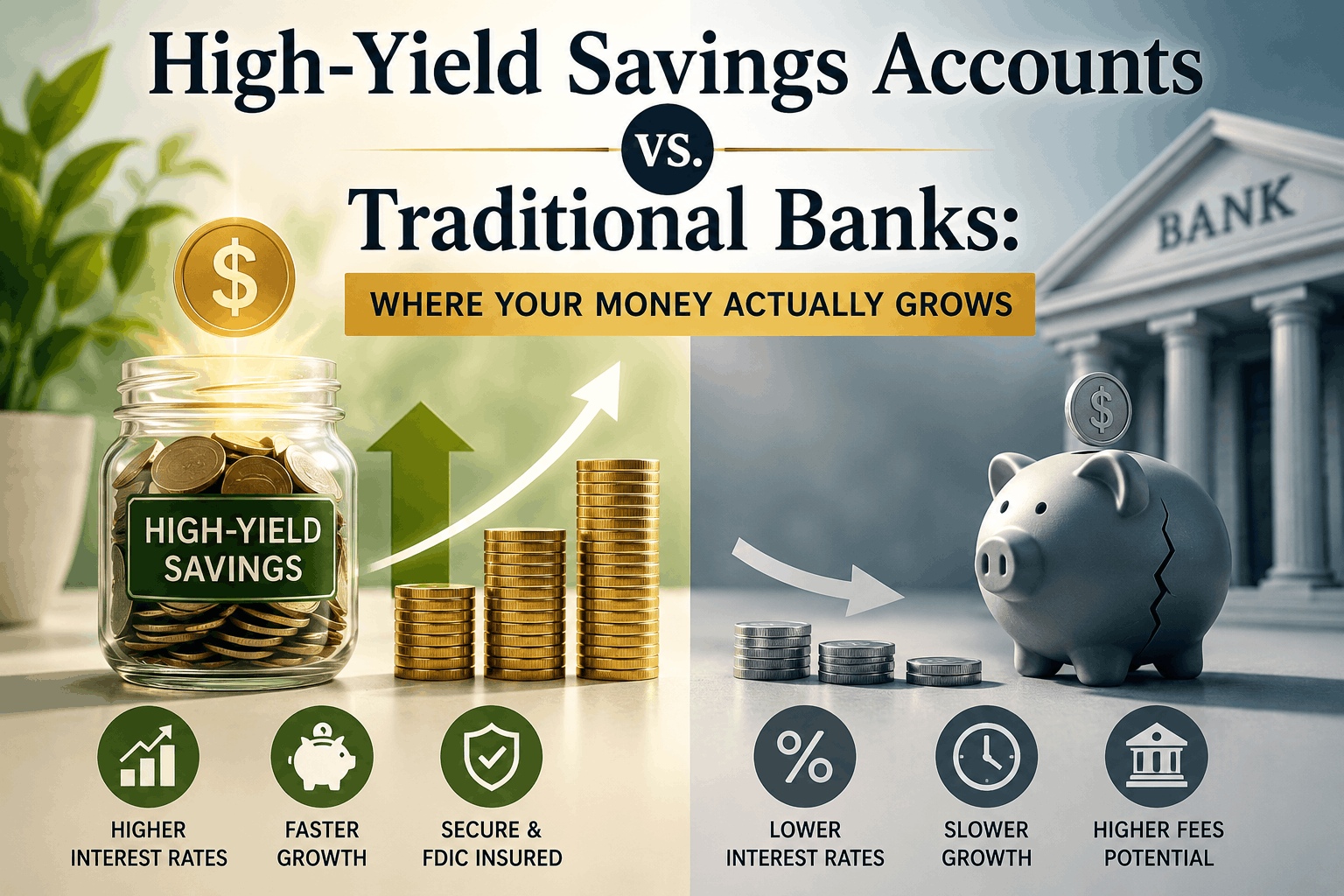
High-yield savings accounts are the go-to choice for most people, on both sides of the Atlantic. In the US, online banks like Ally, Marcus by Goldman Sachs, or Discover regularly offer significantly better interest rates than traditional brick-and-mortar banks, often with no minimum balance requirements. In the UK, easy-access savings accounts from providers like Chase UK, Marcus by Goldman Sachs UK, or various building societies offer similar functionality, letting you earn a reasonable return while keeping same-day or next-day access.
Money market accounts offer a similar structure to high-yield savings, sometimes with slightly better rates, though they occasionally come with minimum balance requirements or limited monthly transactions.
Cash ISAs (UK specifically) are worth genuine consideration for UK readers, since they let your savings grow tax-free up to the annual allowance, which is a meaningful advantage if you’re disciplined enough to treat the account as untouchable except for real emergencies.
A word of caution about certificates of deposit (CDs) or fixed-term savings bonds: these often offer better interest rates, but they lock your money away for a set period, with penalties for early withdrawal. This directly conflicts with the liquidity requirement of an emergency fund. If you use these at all, do it only with money beyond your core fund, not the fund itself.
The One Split Worth Considering
Some financial planners suggest splitting your fund: one to two months of expenses in an easily accessible checking or savings account for true immediate access, with the remaining four to five months in a high-yield savings account that might take a day or two longer to transfer but earns meaningfully better interest in the meantime. This isn’t necessary for everyone, but if you’re chasing every bit of optimization, it’s a reasonable approach.
The Actual Strategy: How to Build It Fast
Here’s where most emergency fund advice falls short. It tells you why you need one and how much, then leaves you staring at a spreadsheet wondering how you’re supposed to find thousands of dollars you don’t currently have lying around.
Let’s fix that.
Step 1: Start With a Smaller, Immediate Target
Before you chase six months, chase one month. Specifically, aim for $1,000 to $1,500 (or roughly £800 to £1,200) as fast as humanly possible within 30 days if you can manage it.
This isn’t your final goal. It’s a psychological and practical buffer that covers the most common small emergencies a car repair, an unexpected medical copay, a broken appliance without derailing your progress or forcing you onto a credit card. Financial behavior research consistently shows that people who hit an early, achievable milestone are significantly more likely to continue saving than those facing one enormous, distant target the whole way through.
Step 2: Audit Your Expenses Like You Actually Mean It
Most people underestimate their spending by a wide margin, not out of dishonesty, but because small recurring charges hide in plain sight. Pull your last two to three months of bank and credit card statements and go through them line by line.
Look specifically for:
- Subscriptions you forgot you had (the average person has at least one)
- Duplicate services (two streaming platforms you barely use, for instance)
- Recurring small purchases that add up quietly, like daily coffee or frequent food delivery
This isn’t about eliminating every source of enjoyment in your life. It’s about finding the money that’s already leaving your account without adding any real value, and redirecting it somewhere that does.
Step 3: Automate the Transfer, Every Single Payday
This is, without exaggeration, the single most effective tactic in this entire guide. Set up an automatic transfer to your emergency fund account the day your paycheck arrives, before you have the chance to spend that money elsewhere.
Even a modest amount $100 or $150 a paycheck — adds up faster than people expect, and automation removes the willpower requirement entirely. You’re not relying on remembering to save what’s left at the end of the month, because there’s rarely anything left at the end of the month. You’re paying your future security first, the same way you’d pay rent.
Step 4: Redirect Windfalls Immediately
Tax refunds, work bonuses, cash gifts, side income, that one week your side gig randomly took off. These irregular sums of money are some of the fastest ways to accelerate an emergency fund, precisely because you weren’t relying on them for regular expenses in the first place.
A tax refund of $2,500 or £1,800, dropped directly into an emergency fund, can compress months of gradual saving into a single afternoon. The temptation, understandably, is to treat windfalls as fun money. Consider committing to putting at least half of any windfall toward your fund until you hit your target, and enjoy the rest guilt-free.
Step 5: Create a Temporary Income Boost
If your timeline genuinely matters say, you’re in an unstable job or industry and want this fund built quickly rather than gradually consider a temporary income increase specifically earmarked for this goal. This could mean picking up freelance work, selling items you no longer use, driving for a rideshare service on weekends, or taking on overtime if it’s available.
The key word is temporary. This isn’t about permanently overhauling your life. It’s about a focused, time-limited push to compress your timeline, with a clear endpoint once you hit your target.
Step 6: Use a Visual Tracker
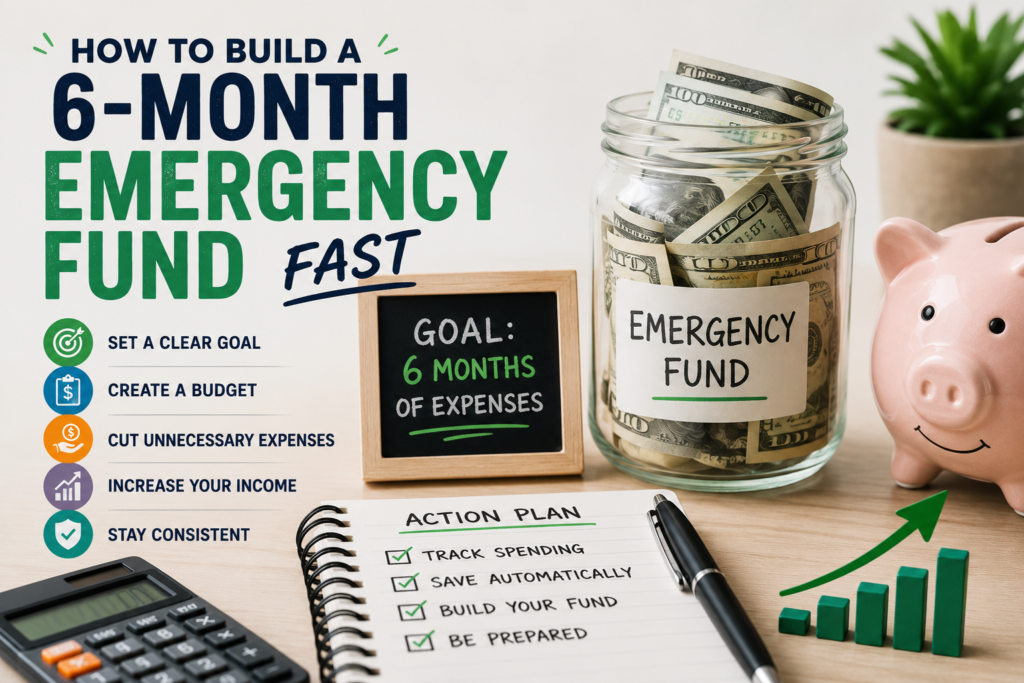
There’s real psychological value in watching progress visually rather than just checking an account balance occasionally. A simple thermometer chart, a savings tracker app, or even a basic spreadsheet with a progress bar can keep motivation alive during the middle stretch of the journey, which is usually where people lose steam.
The beginning feels exciting. The end feels close. The middle is where most emergency funds stall out, precisely because the progress feels invisible without something tracking it for you.
A Realistic Timeline Example
Let’s say your target is $15,000, and you’re starting from zero.
If you can consistently save $500 a month through a combination of automated transfers and expense trimming, you’ll hit your target in 30 months two and a half years. That might sound slow, but remember: you’re not unprotected during that entire time. By month two, you’ve already covered that first $1,000 buffer. By month twelve, you’ve built roughly four months of smaller emergency coverage, which is already a dramatically different financial position than where you started.
If you add windfalls say, a $2,000 tax refund and a $1,000 bonus over the course of a year — combined with a temporary income boost of an extra $200 a month for six months, you could realistically compress that timeline down to somewhere between 18 and 20 months.
The point isn’t to hit six months of savings overnight. Almost nobody does. The point is to build momentum immediately, protect yourself incrementally along the way, and steadily close the gap.
What If Six Months Genuinely Isn’t Realistic Right Now?
Let’s be honest about something a lot of personal finance content glosses over: for some people, especially those with irregular income, high existing debt, or dependents, six months of expenses is a genuinely distant goal, not a quick sprint.
If that’s you, here’s what actually matters:
Something is dramatically better than nothing. Even $500 in accessible savings changes how you handle a small crisis. It’s the difference between a flat tire being an inconvenience versus a financial emergency that spirals into credit card debt.
Build in stages, and celebrate each one. One month of expenses. Then three. Then six. Each stage is a genuine milestone worth acknowledging, not just a waypoint to rush past.
Balance debt payoff and emergency savings simultaneously, rather than choosing one exclusively. A common piece of advice is to build a small starter fund first, then aggressively attack high-interest debt, then return to building the full six-month fund once that debt is cleared. This prevents new debt from being created by emergencies that occur mid-payoff.
Adjust your target based on your actual risk factors. A single-income household, a freelancer with unpredictable earnings, or someone in a volatile industry might reasonably need closer to eight or nine months. A dual-income household with stable employment and no dependents might comfortably manage with three to four months. Six is a solid general benchmark, not a one-size-fits-all mandate.
The Mindset Shift That Actually Makes This Work
Here’s something worth sitting with: an emergency fund isn’t really about the money itself. It’s about the peace of mind that comes from knowing a single bad month won’t unravel everything you’ve built.
People who successfully build these funds tend to share one mindset trait in common — they stop viewing the fund as money they’re “missing out on” and start viewing it as insurance they’re actively purchasing. You don’t resent paying for car insurance even though you hope you never need to use it. An emergency fund deserves that same reframing.
It’s also worth remembering that this fund isn’t meant to sit there permanently untouched, gathering dust as some kind of monument to your discipline. It exists to be used when a real emergency happens, and then rebuilt afterward. Using it as intended isn’t a failure. It’s the entire reason you built it.
Final Thoughts
Building a six-month emergency fund fast isn’t really about finding some secret shortcut nobody’s told you about. It’s about stacking a handful of consistent, unglamorous habits on top of each other: automating your savings, redirecting windfalls, trimming the spending that isn’t adding real value, and tracking your progress so the middle stretch doesn’t feel invisible.
The number itself — six months of essential expenses might feel distant right now. That’s fine. It felt distant to everyone who eventually got there too. What matters is the direction, not the speed. Start with your first $1,000. Automate what you can. Redirect what shows up unexpectedly. And trust that the version of you dealing with a future emergency will be endlessly grateful for the version of you who started today, even in a small, imperfect way.
That’s the real return on an emergency fund. Not just the number in the account, but the steadiness it buys you when life inevitably throws something unexpected your way.
Frequently Asked Questions
1. Should I build my emergency fund before or after paying off debt?
It depends on the interest rate. Most financial advisors recommend building a small starter fund of $1,000–$1,500 first, then aggressively tackling high-interest debt (anything above roughly 7-8%), and finally returning to build out the full six-month fund once that debt is cleared. This prevents a new emergency from putting you right back into debt mid-payoff.
2. Is six months really necessary, or is three months enough?
Three months is a reasonable minimum, especially for dual-income households with stable jobs. Six months is the more commonly recommended benchmark because it accounts for longer job searches and the possibility of multiple things going wrong at once. Your ideal number depends on your job stability, number of income earners in the household, and dependents.
3. Can I keep my emergency fund in a Roth IRA or other retirement account?
It’s not recommended as your primary emergency fund location, even though Roth IRA contributions (not earnings) can technically be withdrawn without penalty in the US. The risk is that touching a retirement account, even partially, can disrupt long-term compounding and create tax complications. Keep this fund separate in a dedicated high-yield savings account instead.
4. What counts as a real emergency versus something I should just budget for?
A genuine emergency is unexpected, necessary, and urgent job loss, a medical bill, an essential car repair, an emergency flight home. Predictable expenses like holiday gifts, annual insurance renewals, or a friend’s wedding aren’t emergencies; they’re just irregular expenses that deserve their own separate savings category so they don’t quietly drain your emergency fund.
5. Should I invest my emergency fund in the stock market to grow it faster?
No. The entire purpose of this fund is stability and immediate access, and the stock market offers neither in the short term. A market downturn coinciding with a job loss is a realistic scenario, and it’s exactly the situation this fund is meant to protect you from. Keep growth-focused investing separate from your emergency fund.
6. How do I stay motivated during the slow middle stretch of saving?
Use a visual tracker (a simple progress bar or savings app works well), celebrate smaller milestones like your first $1,000 or your first full month covered, and remind yourself that automated transfers mean progress is happening even on weeks it doesn’t feel like it. The middle stretch feels invisible specifically because there’s no visible finish line yet tracking fixes that.
7. What if I have irregular income, like freelance or commission-based work?
Base your essential expense calculation on your average monthly costs, and consider building toward eight or nine months instead of six, since irregular income carries more risk. During higher-earning months, redirect a larger percentage toward your fund rather than adjusting your lifestyle upward.
8. Is it okay to use my emergency fund for a “good” opportunity, like a house down payment or a business investment?
Generally, no mixing emergency savings with opportunity-based goals defeats the purpose of the fund, since the money may not be available when a genuine emergency hits. It’s usually better to build separate savings accounts for specific goals like a down payment, keeping your emergency fund untouched and clearly labeled for true emergencies only.
9. How quickly can I realistically access money from a high-yield savings account in an emergency?
Most high-yield savings accounts, both in the US and UK, allow transfers to a linked checking account within one to two business days. Some offer instant transfers for a small fee or through linked debit cards. This is part of why a small buffer in an immediately accessible account, alongside the larger high-yield balance, can be useful for true same-day needs.
10. What happens after I use my emergency fund do I start over from zero?
Not from zero, but you do need to prioritize rebuilding it. Treat replenishing the fund the same way you treated building it initially: automate contributions, redirect any windfalls, and consider it a priority alongside (or even above) other financial goals until it’s back to your target level. Using the fund as intended isn’t a setback it’s the fund doing its job.